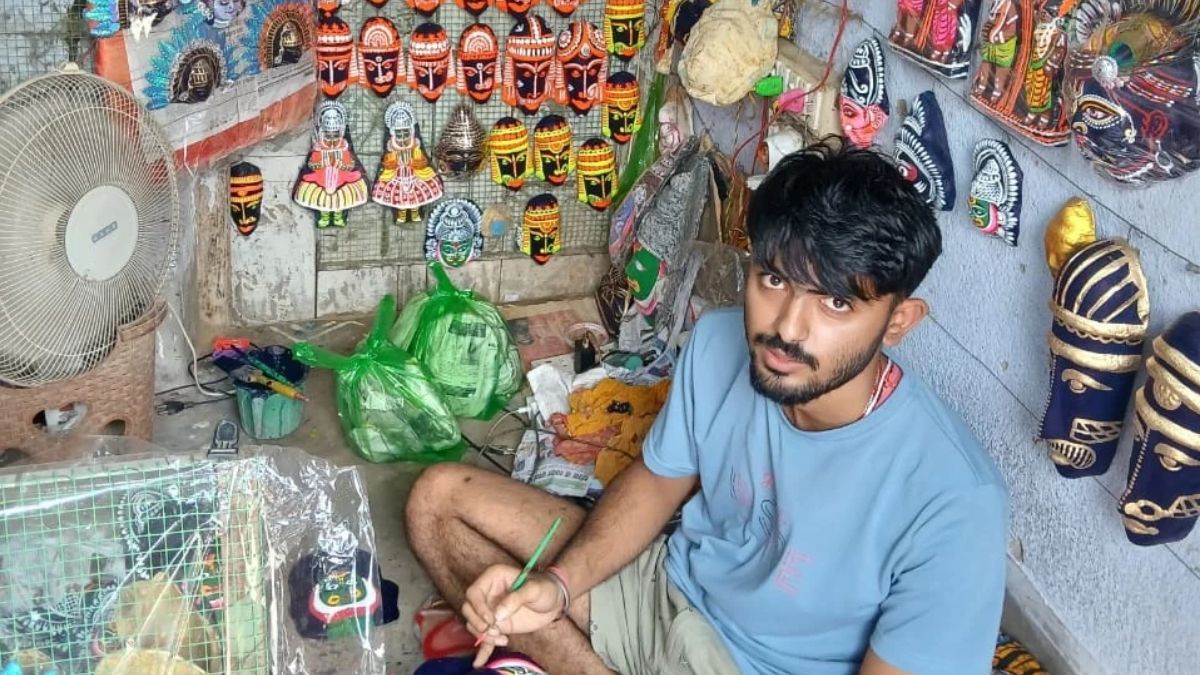
A young generation carries forward Charida’s 150-year-old mask-making tradition
PURULIA: The first thing that catches the eye in Charida is the colour.
Masks hang outside houses and fill small workshops. There are faces with wide eyes, thick eyebrows and long moustaches. Some are painted red, some blue and some green. Many wear elaborate crowns, while others have beards, hair and ornaments that make them look almost alive.
For a visitor, it can feel as if the village is full of faces.
For the people who live here, however, these masks are part of everyday life.
Charida, in Baghmundi block of Purulia district, is known as the Mukhosh Gram, or village of masks. The village is closely associated with the masks used in Purulia Chhau, the traditional dance form in which performers portray characters from mythology and folklore.
The masks are made by hand, mostly by families who have learnt the craft from those who came before them.
One of the younger people learning that craft is Mintu.
He is still studying, but alongside his books and classes, he is learning the work that has been part of Charida’s identity for generations.
His story is a reminder that the future of the craft will depend not only on the older artisans who have kept it alive, but also on young people willing to learn it.
Where the tradition began
The history of mask-making in Charida is closely connected with Purulia Chhau.
Chhau is performed in parts of eastern India, including Purulia, Seraikella and Mayurbhanj. Each region has developed its own style. In Purulia, the masks are particularly elaborate and form an important part of the performance.
The mask-making tradition in Charida is generally believed to be around 150 years old. Accounts of the craft trace its development to the period of the Baghmundi royal family and the artisans who became associated with mask-making in the area.
Local tradition also remembers an early artisan named Buddeshwar, who is associated with some of the older mask-making traditions of the village. Among the figures linked with him are Kirat and Kiratani, representing Shiva and Parvati.
Over the years, the range of masks grew.
Characters from the Ramayana and Mahabharata became part of the craft. Gods, goddesses, demons, animals and warriors all found their place in the workshops of Charida.
Today, artisans also make masks for the souvenir market and experiment with subjects and designs beyond traditional Chhau characters.
The craft has changed with time, but the basic idea remains the same: a mask has to give a character a face.
How a mask is made
The finished masks are striking, but their raw materials are surprisingly ordinary.
Clay is used to prepare the mould. Paper and cloth are then used in layers to build the mask. After it has dried and become firm, the mask is removed from the mould and its surface is carefully smoothed.
Only then does the face begin to take shape.
The artisan decides where the eyes will sit, how large the eyebrows should be and what expression the character should have. Colours are added according to the character.
Then comes the decoration.
Beads, sequins, zari, foil, artificial hair and other materials are used to give the masks their distinctive appearance. Some masks also have large headpieces that are almost as elaborate as the faces themselves.
The work is slow and requires a steady hand.
There is also no single formula that works for every character. An artisan has to know what makes a particular face look like a god, a demon, a warrior or another figure.
That knowledge comes with practice.
A family craft
For many artisans in Charida, mask-making begins at home.
Children grow up seeing their parents and other family members working with clay, paper and paint. They watch the process before they start helping with small tasks themselves.
The learning is often informal.
An older artisan demonstrates something. A younger person tries it. If the shape is wrong or the decoration does not sit properly, it is corrected.
Over time, the work becomes familiar.
Women are also an important part of this process in many households, particularly in decoration and finishing work. Attaching ornaments, beads and sequins and preparing some of the elaborate decorative elements can involve several members of the family.
So although a mask may be sold under the name of one artisan, making it can be a collective family effort.
Mintu’s two worlds
Mintu’s story is slightly different from that of an artisan who has spent his entire life in the workshop.
He is still a student.
His day involves studies, but he also spends time learning and making masks.
The two worlds sit side by side.
There are textbooks and classrooms on one side. On the other are clay moulds, sheets of paper, paint and brushes.
For Mintu, mask-making is not something he has discovered recently as a tourist attraction or a business opportunity. It is a craft that exists around him and has been passed through generations.
At the same time, education has opened up possibilities that were not available to many of the artisans who came before him.
That makes his story important.
Traditional crafts across India face a similar problem. Young people have more choices today. They can study, move to cities and look for jobs outside their family occupations.
A craft that requires patience and years of practice has to compete with those possibilities.
Mintu is still at the stage where both worlds remain part of his life.
Mintu’s mother is also a mukhosh maker and has even appeared as a participant on the popular Bengali television game show Didi No. 1.
Learning the craft while planning a future
There is no guarantee that every young person who learns mask-making will eventually make it their full-time profession.
That is perhaps the reality Charida has to accept.
Preserving a tradition cannot necessarily mean asking young people to give up other ambitions.
Instead, the challenge may be to make sure they do not lose the connection completely.
Mintu’s experience shows one way that can happen.
He can continue his education while learning the craft. Even if his future takes him into another field, the skill he has learnt can remain with him.
And if enough young people do the same, the knowledge will not disappear when the older generation retires.
From the Chhau stage to people’s homes
The masks of Charida were originally made mainly for Chhau performances.
But their market has expanded.
Visitors come to the village looking for smaller masks to take home. The pieces are also bought as decorative objects and souvenirs.
This has given artisans another market beyond dance performances.
The popularity of Purulia Chhau has helped bring greater attention to the masks as well. In 2018, the Purulia Chhau Mask received a Geographical Indication (GI) tag, formally recognising its connection with the region.
For artisans, however, recognition alone does not solve everything.
They still have to find buyers, manage the cost of materials and make sure the work provides a reasonable income.
The craft also has to compete with factory-made decorative products that can be produced much more cheaply.
The mask and the dancer
A Chhau mask has a purpose that goes beyond decoration.
Once it is placed on a dancer’s face, the dancer’s own identity largely disappears. The character represented by the mask takes over.
The dancer’s movements, the music, costume and the expression of the mask work together.
That is why the relationship between the artisan and the performer is so important.
The artisan creates the face.
The dancer gives it movement.
Without the performer, the mask is an object. Without the mask, many of the characters of Purulia Chhau would lose an important part of their visual identity.
A tradition trying to keep pace with time
Charida is no longer a village known only to people who follow Chhau.
Tourists, photographers, researchers and buyers now visit the village. The masks have travelled well beyond Purulia.
But popularity brings its own complications.
Artisans have to balance traditional methods with changing tastes. They have to decide what to preserve and what can be changed. And they have to convince younger members of their families that the craft is worth learning.
The younger generation may not follow exactly the same path as their parents.
That does not necessarily mean the tradition is ending.
It may simply mean that the tradition is changing shape.
The future of the mukhosh
In Charida, the masks tell stories about gods, demons, warriors and mythical characters.
But the most important story may be happening quietly inside the workshops.
It is the story of the people who continue to make them.
And increasingly, it is the story of young artisans like Mintu.
He is still studying. He has a future that may take him in several different directions. Yet he is also learning a craft that has survived in Charida for generations.
That makes his hands important.
Not because he has to become a mask-maker for the rest of his life, but because every skill that passes from one generation to another gives the tradition another chance to survive.
The future of Charida’s masks may not look exactly like its past.
Some young artisans may leave. Some may take up other professions. Some may return to the workshop. Others may find new ways to sell and promote the craft.
But as long as someone is willing to sit down, shape the clay, smooth the paper, pick up the brush and begin painting a face, the story continues.
In Charida, the masks may hide the faces of the Chhau performers.
But behind every one of them is another face worth remembering—the face of the artisan.
And now, among those artisans, there is a young student named Mintu, learning an old craft while preparing for a future of his own.